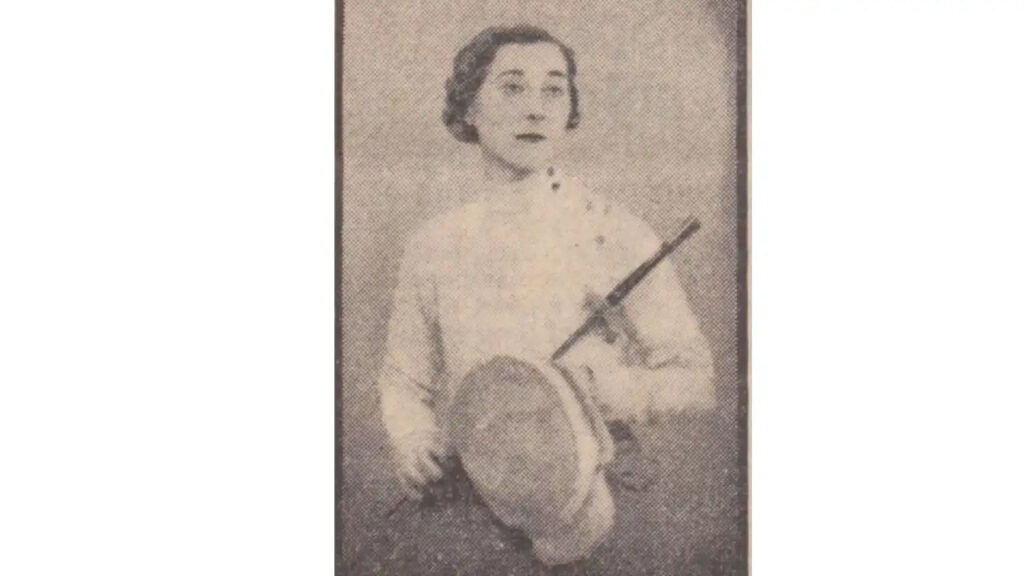
Frances Sapcote (1891-1962) was the spouse of William Wilkinson Sapcote (O.B.E.) which was the owner one of the largest building firms in Birmingham. Her husband was a fencer and heavily involved in the running of fencing in the West Midlands region. But arguably it is his wife Frances who was for many years one of the most influential of women fencers in Britain.
International Competitor and promoter of fencing in the West Midlands.
Mrs Sapcote represented Birmingham in women’s foil at the Tournoi de Dieppe in September 1932. She was Vice-Captain in 1933 of the women’s section of the Birmingham fencing Club, which included Mrs R.E Cole (captain), Miss A. Hasluck and Miss M. Thompson, Miss K.M. Twist and regularly fenced around the country against other fencing clubs.

She was instrumental in organising the first Leamington Tournament, the forerunner of what would later become the Birmingham International Tournament, (A tournament that is still running today and SCFC members help run and organise) and provided the original Sapcote trophy for women’s foil event which began on March 31st 1934, with the Birmingham team she captained of coming second in the women’s team foil competition.
She also provided the Trophy for the Women’s Challenge Felix Grave cup in 1936, named after the late fencing master Felix Grave, who she took lessons from, and in May of that same year was the co-founder of the Ladies Professional Fencing Association, the women’s association for professional fencing instructors.
She represented Birmingham at the International Le Touquet-Paris-Plage alongside Miss Scott-Elliott and Miss J. Winder in August 1936, and then once again in 1938 alongside Miss Lyn Teesdale and Miss Janet Tomblin, where she was noted by the French for her ‘elegant type of fencing’.
She also continued her international presence at International tournaments: she was a referee at the 1948 London Summer Olympic games and was selected to be the manager of the women’s British fencing team sent to the world Games at Monte Carlo on the 9th July 1950. She was also later the official team manager for the women’s team sent at the Copenhagen world championships in June 1952 and for the women competing at the Helsinki Olympic games in 1953.
After the Second World War war she was heavily in involved in the running of the West Midland’s Section (now called the West Midlands Region) alongside her husband, helping with the formation of newer clubs being created in the region, was a long term elected member of the Amateur Fencing Association (AFA) between 1950 and 1960 and was on the committee of the Ladies Amateur Fencing Union.
When the old Headquarters of the AFA which shared its building with the London Fencing club (est.1848) on Tenterden Street burned down in 1962, a new headquarter had to be built. Amongst the fund raising enterprises was that a list of costs of component parts was circulated around the various clubs and individuals in Britain so that anyone could donate an actual parts from the roof or the flooring. Most Clubs opted for the equivalent of 100 bricks which was £4 (Which incidentally our club actually donated after holding an emergency meeting). The Birmingham Fencing Club donated the staircase to the Gallery and Mrs Sapcote donated the entrance doors. The De Beaumont Centre, based in West Kensington as it came to be known opened these doors in October 1963.
Traveller and Student of Languages
She was an ardent student of languages having first learned French in 1917 in order to visit a French farmer her husband had met during the First World War. She also spoke German and Italian, studying the latter at Birmingham University and travelled to Italy between March and May 1939 sit a course on Dante at the University of Florence and also to do some fencing under the Italian system of Fencing. She latter added knowledge of Finnish, Norwegian Danish and Swedish when she managed the British team at the 1953 Olympics. She was a prominent member of the Birmingham Anglo-French society in the 1950’s.
Pioneer of Women’s Epee and Sabre Fencing
Frances became interested in Epee after she took part in a women’s foil competition in Dieppe in 1930 and saw a women’s epee contest being demonstrated. She the introduced Epee to the women members of Birmingham Fencing Club in 1931and went on to enter a women’s Epee contest in France in 1932.
As a proponent of Epee for women, her reasoning was that when women advanced into the middle years that the continuous lunging of foil was often too strenuous and not advisable, and that epee demanded nimble brains and more cautious defensive tactics.
Women Epee fencers continued to face a great deal of opposition to their inclusion and to overcome this she founded the Women’s Cercle d’Epee the only club of its kind in the Great Britain. It was originally formed of 9 founder members – Mrs Sapcote, (Birmingham), Miss F. Harmsworth (Salle Froschlein), Miss D.H. Dancey (Salle Bertrand), Miss L. Teesdale (Salle Grave), Miss J. Tomblin (Salle Grave), Miss M. Pollock-Smith (Salle Bertrand), Miss P. Scadding (Isle of Wight), Miss D. Warskett (Sussex S.C.), Miss L.M. Weybridge.
These staged the very first British women’s epee tournament – The Scott-Elliot Challenge Cup on July 8th, 1939, at the Kensington country Club. As was customary at the time the Epee Tournament initially was held outdoors at the Kensington Country club simulating the conditions of a duel with a point d’arret, but the treacherous British weather and rain conspired to forcing the women indoors so the competition was completed indoors at Salle Grave in London. Mrs Sapcote won the tournament becoming women’s first ever British women’s Epee Champion.

She also went on to stage exhibits in Sabre prior to 1950 a discipline that took even longer to be universally accepted. She was quote a vocal proponent going as far as to say in an article:
“The Victorian man would have cried out in a loud voice saying that that kind of thing was unsuitable for women. But the truth is that sabre fighting is no more dangerous than foil fighting – you just pad yourself and let the padding take the slash”
– Sunday Mercury 1st July 1951.
It might seem extraordinary nowadays but the first women’s Olympic epee event only took place at the Atlanta Olympics in 1996. Women’s Sabre took even longer to be accepted premiering at the 2004 Athens Olympics. This West Midlands pioneer of women’s alas passed away on 19th November 1962, being survived by her sons Basil and Elwin who were also fencers.
The Sapcotes at Sutton Coldfield Fencing Club
The whats the connection with our club? Her husband William Wilkinson Sapcote (OBE) was our first President, being already regional section chairman and accepting the role of first honorary President of SCFC in the first year of its formation, and stayed there for one year before commitments made him resign his chair.


Councillor J.J. Potter the Vice-President would later become the mayor of Sutton Coldfield in 1960.
This was a meeting Mrs Sapcote also attended. She was by that time was Life-Vice Chair of the West midlands AFA. Not only that but she donated funds to the club with which a trophy was purchased for the women’s foil competition at the Sutton Coldfield Fencing Gala’s that took place between 1961- 1963. A letter of thanks was sent to her by our then club secretary Sandra Whodcoat on behalf of the club.

As a club we hope to continue in this tradition to encourage and inspire new generations of women to take up fencing.
GFM